

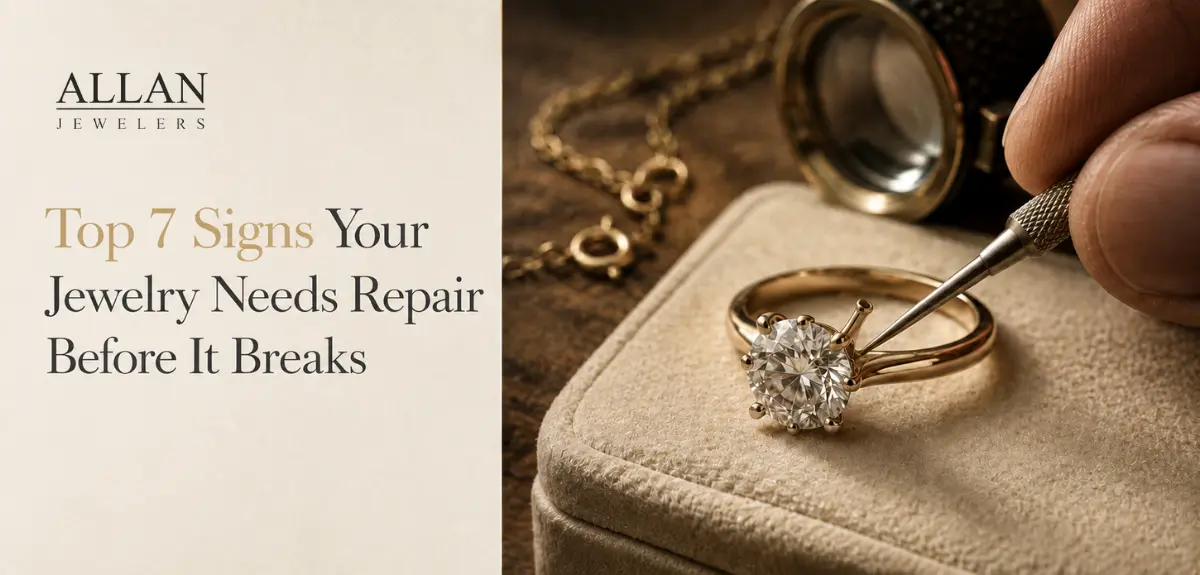
Loose diamonds, worn prongs, unreliable clasps, and damaged watch crystals often show warning signs before a piece is lost or seriously damaged. Use this checklist to recognize when you should stop wearing the item and have it professionally inspected.
RINGS Loose diamonds, worn prongs, and poor fit | CHAINS Weak links and unreliable clasps | WATCHES Lost time and damaged crystals |
Most jewelry failures are preceded by smaller warning signs: a diamond that shifts, a prong that catches on fabric, a clasp that opens unexpectedly, or a ring that no longer fits safely. Ignoring these changes can turn a straightforward repair into a lost diamond or missing piece.
If you notice any of the seven signs below, stop wearing the item until a jeweler can inspect it. Continuing to wear damaged jewelry can place additional stress on the setting, chain, clasp, or diamonds.
Quick answer: Jewelry may need repair if a diamond moves, prongs appear worn, a clasp opens unexpectedly, a chain link looks thin, a ring consistently slips or pinches, a watch loses time, or a watch crystal is cracked.
How Can You Tell If Jewelry Needs Repair?
A Diamond That Wiggles or Feels Loose
If a diamond or gemstone moves, clicks, or shows a visible gap between the diamond and its setting, stop wearing the piece. GIA’s guidance on protecting a diamond engagement ring identifies diamond movement and visible gaps as warning signs that a prong may be loose. Avoid repeatedly pushing the diamond to test it. Store the piece safely until a jeweler can inspect the setting.
Prongs That Look Thin, Bent, Flat, or Uneven
Prongs can wear down, bend, or begin catching on hair and clothing. Prong retipping adds metal to worn tips, while more extensive damage may require part of the setting to be rebuilt. Even if the diamond does not move yet, a damaged or noticeably uneven prong should be inspected before regular wear continues.
A Ring That Consistently Spins, Pinches, or Slips
A ring that consistently spins, slides over the knuckle, pinches, or causes redness may need resizing. Finger size can temporarily change with temperature, activity, and fluid retention, so one unusual day does not necessarily mean the size is wrong. If the fit remains unsafe or uncomfortable across different days, have the ring professionally measured. The American Gem Society’s ring sizing guidance also notes that finger size can change throughout the day.
A Weak Chain Link or Clasp That Opens Unexpectedly
Stop wearing a necklace or bracelet if the clasp opens without being pressed, the connecting jump ring separates, or one chain link appears stretched or thinner than the others. A jeweler may be able to solder the damaged area, replace the clasp, or reinforce the weak connection before the piece is lost. Heavily worn chains may require more extensive work or replacement.
A Watch That Stops or Loses Time
A depleted battery is one possible cause when a quartz watch stops, but it is not the only explanation. Mechanical, automatic, and light powered watches operate differently and may stop because of low power, movement wear, impact, or another internal problem. Have the movement type and condition checked before assuming that the watch only needs a battery.
A Watch Crystal That Is Chipped, Cracked, or Loose
A light surface scratch may be primarily cosmetic, but a crack, chip, or gap around the crystal requires quicker attention. Damage that compromises the crystal or its seal may allow moisture or debris to reach the dial and movement. Stop wearing the watch around water and have the crystal and gasket examined.
Jewelry That Remains Dull After Gentle Cleaning
Jewelry can remain dull because of lotion, oil, soap residue, fine scratches, worn plating, or buildup beneath the setting. Cleaning methods also vary by gemstone, treatment, and construction. White gold that has developed a yellowish tone may need professional rhodium plating rather than additional cleaning. GIA’s cleaning and maintenance guidance also recommends checking that diamonds are secure before ultrasonic cleaning.
Why Should Damaged Jewelry Be Repaired Early?
The main reason to act early is to limit additional damage and reduce the risk of losing the entire piece. A worn prong may eventually stop holding a diamond securely, while a weak clasp can allow a necklace or bracelet to fall without notice. Repair cost and turnaround time depend on the metal, setting, gemstones, construction, and extent of the damage, but early inspection gives the jeweler more options.
If the original diamond has already been lost, ALLAN Jewelers can help you evaluate suitable replacement diamond options for the existing setting.
Which Jewelry Services Can Be Completed While You Wait?
Many routine repairs can be completed in as little as 5 to 20 minutes, including watch battery replacements, minor chain repairs, minor watch repairs, and jewelry cleaning.
Timing begins with an inspection of the actual piece. Watch battery replacement, link adjustment, and complimentary jewelry checking and cleaning may be available while you wait at the Beaver showroom. Rhodium plating is generally completed within 48 hours.
Ring resizing, chain soldering, prong retipping, diamond setting, and structural restoration require a piece-specific evaluation before a turnaround estimate can be provided. Call ahead if you are working with a deadline.
Get Your Jewelry Inspected in Beaver, PA
ALLAN Jewelers has served Beaver area clients since 1920. Complimentary checking and cleaning are available on most pieces at the Beaver showroom. Sizing, soldering, and diamond or gemstone setting work is not mailed away. Each item is handed directly to and received directly from the jeweler we work with, helping maintain a clear chain of care throughout the repair process.
Explore our jewelry repair and restoration services in Beaver, PA, or bring your piece to 500 Third Street, Beaver, PA 15009 for an inspection.
If an older piece is too worn to repair reliably, our custom jewelry and heirloom redesign service can explore whether its diamonds or metal can be incorporated into a new design.
500 Third Street, Beaver, Pennsylvania 15009
(724) 775-0786 · Mon–Fri 10 am–6 pm · Sat 10 am–5 pm · Sun Closed
Common Questions
Should I keep wearing a ring if the diamond moves?
No. Stop wearing the ring and store it safely until the setting can be inspected. Continued movement may place additional stress on the prongs and increase the risk of losing the diamond.
How often should jewelry be professionally inspected?
Jewelers Mutual recommends professional inspections and cleaning twice a year. Jewelry worn daily or exposed to frequent impact may need more regular checks.
Does a stopped watch always need a new battery?
No. A battery is a common cause for a stopped quartz watch, but mechanical, automatic, solar, and light powered watches may stop for different reasons. The watch should be diagnosed before a repair is recommended.
How can I tell whether a chain clasp is failing?
Warning signs include a clasp that opens without being pressed, a spring mechanism that feels weak, a bent connecting ring, or a chain link that appears stretched or thin.
Can every broken chain be repaired?
Many broken chains can be soldered or reinforced, but repairability depends on the metal, construction, link thickness, and overall wear. A heavily worn chain may not be structurally reliable after repeated repairs.